An ecommerce website can cost a few hundred dollars for a self-built store or tens of thousands for a custom Shopify site. The difference comes from the features, content, integrations, and support the business needs.
When analyzing how much does an Ecommerce website cost, enterprise merchants must look past initial launch expenses and evaluate long-term operational overhead. A storefront that appears budget-friendly during the blueprint phase can rapidly become a financial bottleneck when custom product components, ERP integrations, or ongoing maintenance are tacked on without a technical roadmap.
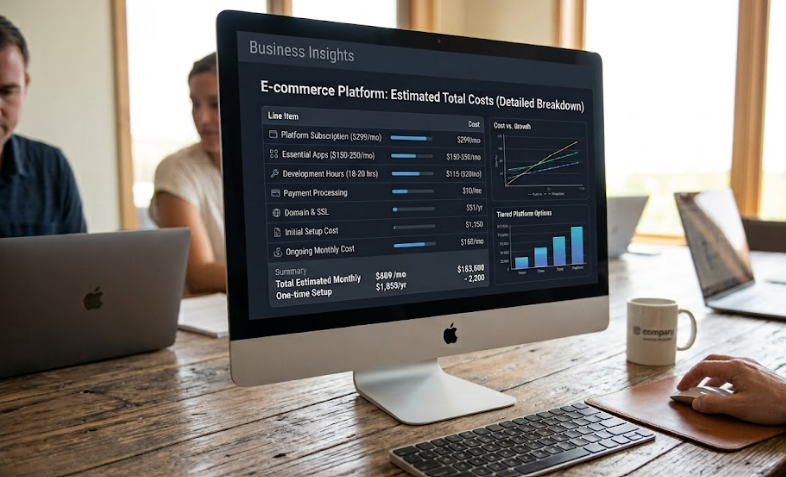
How Much Does an Ecommerce Website Cost for a Basic Store?
A basic store usually has a focused product range, a standard Shopify theme, limited apps, and straightforward shipping rules.
A lean self-built launch can often fall around $500 to $2,000 for initial setup, depending on whether you pay for a theme, product photography, copy, and setup help. A professionally configured small Shopify store may fall around $3,000 to $10,000 when it needs branded pages, stronger product content, and careful mobile setup.
These are broad planning ranges, not standard market prices. They assume a small, single-market store and exclude inventory, packaging, advertising, tax advice, payment-processing charges, and fulfilment costs. A larger catalogue, multi-currency setup, custom integrations, or migration work can raise the final quote.
Securing an expert ecommerce cost planning consultation prevents brands from over-engineering features that add zero operational value.
The Main Costs Behind an Ecommerce Website
Some costs happen once during setup, while others continue each month or whenever the store changes.
| Cost Area | What It Covers | Budget Effect |
|---|---|---|
| Platform and domain | Shopify subscription, domain, and transaction-related charges | Recurring |
| Theme or template | Store layout, page structure, and navigation | One-time or recurring |
| Design and content | Branding, product photography, copy, and banners | Usually upfront |
| Development | Theme changes, product logic, integrations, and data work | Upfront, sometimes ongoing |
| Apps and tools | Reviews, subscriptions, search, email, or shipping tools | Usually recurring |
| Maintenance | Bug fixes, updates, app reviews, and technical improvements | Ongoing |
The defining factor of your long-term balance sheet is not your SaaS subscription fee, but whether your operational workflows can survive on stock theme architecture or demand heavy custom development.
Theme, Template, or Custom Website Build?
A pre-built theme is usually the lower-cost option because much of the store structure already exists. It can work well when product pages, collections, and checkout follow a conventional pattern.
While deploying a generic shopify starter storefront template can expedite a minor product launch, it inherently limits scalability. As complexity scales, investing in specialized ecommerce store visual design becomes mandatory-transforming rigid, pre-built templates into dynamic UX components that actively remove conversion friction.
What Makes an Ecommerce Website More Expensive?
The answer to how much does an Ecommerce website cost changes quickly once the store needs functionality beyond a standard theme.
Costs rise when you need:
- Multiple currencies, languages, or regional storefront changes
- Large catalogues with detailed filtering
- Subscriptions, bundles, or custom product builders
- Custom cart rules, discounts, or shipping logic
- ERP, warehouse, CRM, or fulfilment integrations
- Data migration from another ecommerce platform
- B2B pricing, account approval, or wholesale ordering
Commissioning a specialized custom Shopify store build becomes an operational necessity the moment your tech stack requires deeply tailored API integrations, custom middleware, or automated operational logic that a brittle stack of third-party apps cannot reliably handle.
Do Not Forget Ongoing Ecommerce Costs
The first build cost is only one part of the overall budget. Monthly costs may include the Shopify plan, app subscriptions, transaction charges, email tools, inventory software, customer-support tools, and maintenance.
Review apps regularly. A tool that was useful during launch may no longer be needed. A growing catalogue, however, may need better search, inventory tools, or shipping setup.
New campaigns, app updates, and customer feedback can require storefront changes. For complex features or third-party connections, custom Shopify functionality may be preferable to several apps with overlapping purposes.
How to Set a Realistic Budget
Separate essential launch requirements from optional improvements. Essential work includes a usable theme, complete product pages, payment and shipping setup, mobile testing, policies, and order emails. Optional work may include advanced animations, interactive quizzes, or integrations that are not necessary on day one.
Ask potential partners what is included in the estimate. Confirm the number of templates, product pages, revisions, app setups, integrations, and testing stages. Also ask what will be billed separately after launch.
A low quote may suit a simple store. It becomes expensive when important requirements are left out and added later as urgent fixes.
How Much Does an Ecommerce Website Cost Over Time?
For brands asking how much does an Ecommerce website cost, the better question is whether the budget fits the store’s needs and future plans. A practical first version can launch with a strong product structure and dependable checkout, then add features when the business can justify them.
Zissu Global helps scaling enterprise brands navigate the technical complexities of how much does an Ecommerce website cost, architecting custom storefronts and backend integrations tailored directly to your operational infrastructure.
