Online shoppers often leave a website because they cannot find the right product, compare available options, or get answers before purchasing. These problems are not always obvious from sales reports, especially when a store attracts substantial traffic.
Understanding how AI improves website conversion rate helps Shopify merchants identify where artificial intelligence can make shopping easier and where conventional website improvements remain necessary.
AI can analyze customer behavior, recommend relevant products, assist with purchasing questions, and identify potential conversion barriers. However, the technology does not automatically increase sales. Its effectiveness depends on accurate data, appropriate implementation, and measurable improvements in customer experience.
How AI Improves Website Conversion Rate Through Customer Behavior
Artificial intelligence analyzes information from browsing activity, purchase histories, product interactions, and other available customer data.
Machine learning models can identify patterns that traditional reporting tools may not reveal immediately.
For example, an online clothing retailer might discover that customers frequently browse several sizes before abandoning a product page. This observation could indicate uncertainty about sizing or product fit.
AI-assisted analysis can help merchants investigate these patterns and identify opportunities for improvement.
The objective is not simply to collect more information. Businesses need to translate customer behavior into changes that make purchasing easier.
Where AI Can Improve Ecommerce Conversions
Different AI applications address different stages of the buying journey.
| Conversion Challenge | AI Application | Potential Benefit |
|---|---|---|
| Customers cannot find products | Intelligent product search | More relevant search results |
| Shoppers struggle to compare items | Personalized recommendations | Easier product discovery |
| Product questions remain unanswered | AI shopping assistants | Faster purchasing support |
| Customers abandon checkout | Behavioral analysis | Identification of possible friction |
| Marketing messages lack relevance | Predictive segmentation | Better-targeted campaigns |
These applications explain how AI improves website conversion rate by addressing specific customer difficulties rather than relying on automation alone.
Personalized Product Recommendations
Product recommendations can help shoppers discover items that match their interests.
A recommender system uses information such as user preferences, product characteristics, and interaction patterns to suggest relevant items.
For example, an electronics retailer could recommend compatible accessories based on the product a customer is viewing.
Shopify’s Search & Discovery app supports related and complementary product recommendations. More advanced behavioral personalization may require additional applications.
Recommendations should remain relevant and avoid overwhelming customers with unnecessary suggestions.
AI-Powered Search and Product Discovery
Traditional store search may struggle when shoppers use unfamiliar descriptions or phrases that do not match product titles.
AI-powered search tools can interpret customer intent and improve how relevant products are ranked.
A customer searching for “lightweight running shoes for rainy weather” may receive more useful results when the search system understands product attributes rather than relying exclusively on exact keywords.
Accurate product descriptions, tags, and structured catalog information remain essential.
Poor product data can produce irrelevant results even when the search technology is sophisticated.
AI Shopping Assistants
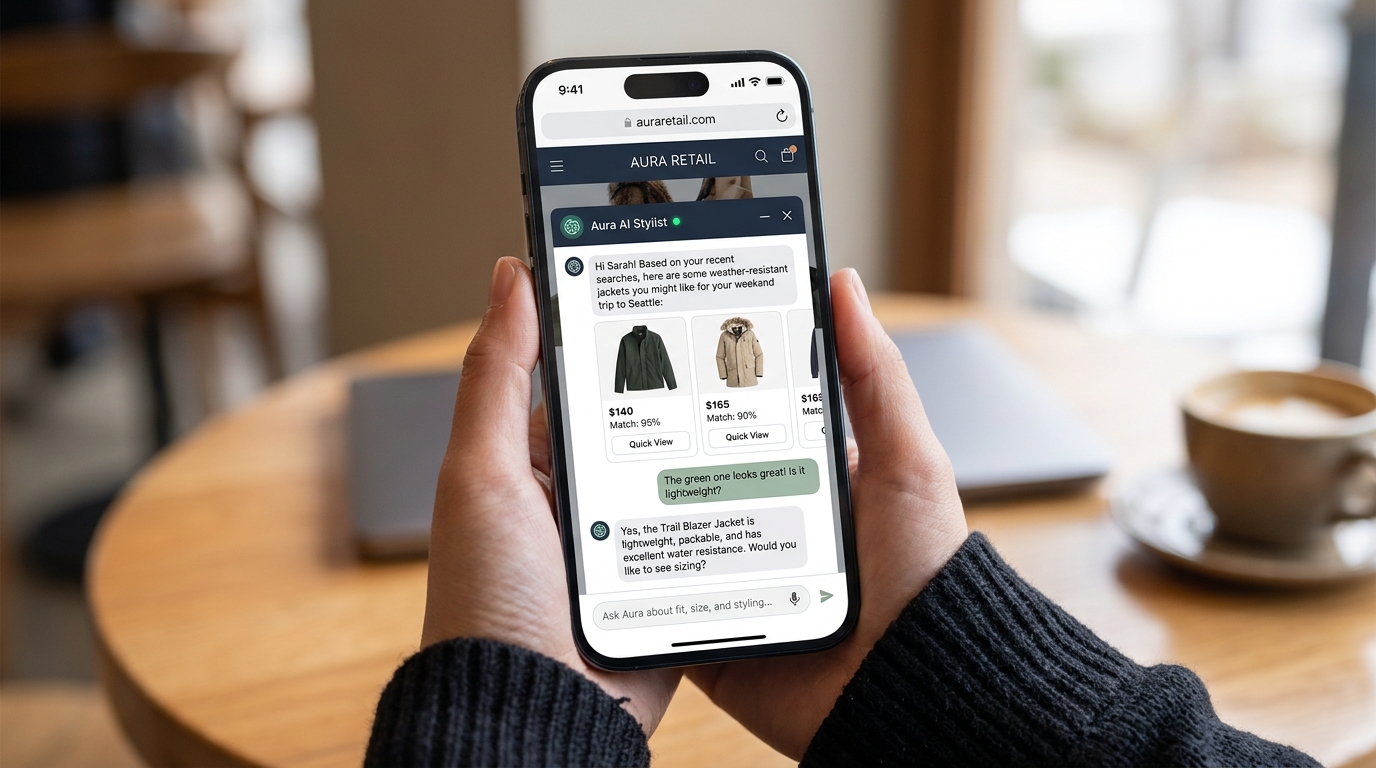
An AI shopping assistant can answer product questions, explain available options, and direct shoppers toward appropriate items.
For instance, a furniture retailer might use an assistant to explain dimensions, materials, delivery restrictions, and assembly requirements.
These interactions can reduce uncertainty before checkout.
However, assistants must rely on reliable product information and provide access to human support when necessary.
Incorrect claims about availability, pricing, or return policies can undermine customer confidence.
Can AI Reduce Checkout Abandonment?
Checkout abandonment has several possible causes, including unexpected shipping costs, unavailable payment methods, and complicated purchasing steps.
AI analytics tools can help identify behavioral patterns associated with these problems.
For example, a merchant may discover that customers frequently leave after viewing shipping estimates.
That observation could justify testing earlier delivery-cost disclosure.
However, AI cannot eliminate checkout restrictions or repair technical problems without appropriate implementation.
Businesses evaluating how AI improves website conversion rate should distinguish predictive insights from actual website changes.
Using AI With Shopify Conversion Rate Optimization
AI-generated recommendations should be treated as hypotheses that require testing.
A Shopify retailer might use AI to identify underperforming product pages, then evaluate whether improved descriptions or product recommendations increase purchases.
A practical measurement process includes:
- Establishing the current session conversion rate.
- Identifying one measurable customer problem.
- Introducing an appropriate improvement.
- Comparing results through controlled testing where feasible.
- Reviewing conversion rate, revenue, and average order value together.
Merchants should also monitor site performance, data privacy, and application costs.
A more personalized experience is not necessarily better if additional scripts slow down the storefront or recommendations become intrusive.
Professional Shopify CRO consulting can help merchants evaluate purchasing barriers and prioritize improvements based on customer behavior.
Does AI Guarantee Higher Conversion Rates?
No. Results vary according to traffic quality, product demand, implementation, and customer needs.
Shopify’s 2026 ecommerce guidance describes AI applications for personalization, product discovery, and conversion analysis, but these capabilities do not guarantee a specific increase in sales.
Merchants should avoid assuming that installing an AI application will automatically improve performance.
The most useful applications solve an identifiable problem and produce results that can be measured against an appropriate baseline.
Conclusion
Understanding how AI improves website conversion rate allows Shopify merchants to evaluate artificial intelligence as a practical ecommerce tool rather than an automatic solution.
Personalized recommendations, intelligent search, shopping assistants, and behavioral analysis can help remove purchasing barriers when implemented appropriately.
Businesses should prioritize accurate customer data, reliable storefront functionality, and measurable results before expanding their AI investments.
Zissu Global helps ecommerce brands identify conversion barriers, improve Shopify storefront usability, and develop shopping experiences aligned with their commercial objectives.